
Although capital gains in Andorra are regulated by the Personal Income Tax Law (commonly known as “Impost sobre la Renda de les Persones Físiques” or IRPF), exemptions, special rules and the absence of double taxation treaties make the taxation of capital gains more complex than that of simple employment income.
For this reason we have written this guide that aims to clarify once and for all how much tax you should pay as an Andorran resident on each type of capital gains.
Capital Gains on the sale of shares
Individuals who receive capital gains are taxed at a rate of 10% with an exemption of the first €3,000.
That said, capital gains on the sale of shares enjoy other exemptions that make the effective rate much lower and often even 0%. Specifically:
- If you own 25% or less of the company, you pay no capital gains tax on the profits from the sale of those shares.
- If you own more than 25% of the company, you would pay up to 10% on the gain, unless you held the shares for more than 10 years. After 10 years, the capital gain becomes tax-exempt.
Important exception: since January 2024 (Llei 5/2023), shares in entities whose assets are composed of at least 50% real estate located in Andorra are treated as real estate transfers. In these cases, the 25% ownership exemption does not apply, regardless of the size of your stake.
In simple terms, if you sell shares in a company where your stake does not exceed 25%, there is a full exemption (provided the company is not primarily a real estate holding entity). If your ownership is more than 25%, the 10% rate applies, unless you have held those shares for 10 years, in which case the gain is 0%.
Practical examples
Imagine you are Andorran tax resident and hold some publicly traded American shares (like Apple or Tesla) and you decide to sell them at a profit. Since your stake in these corporations is certainly below 25%, you generally pay no capital gains tax in Andorra on the sale.
By contrast, if you sold 100% of your Andorran company (assuming you had a large stake of more than 25%) you would pay up to 10% on the capital gain.
However, if you had owned that same company for more than 10 years, you would owe nothing upon sale.
Dividends to non-residents
Dividends paid to non-residents by Andorran companies are not subject to any withholding in Andorra. The non-resident may, however, have to declare them in their country of residence, depending on that country’s rules.
Capital Gains on Real Estate
Real estate capital gains in Andorra were historically taxed under a standalone law, the Impost sobre les Plusvàlues en les Transmissions Patrimonials Immobiliàries. However, this law was derogated by Llei 5/2023, effective 1 January 2024, and real estate gains are now fully integrated into the IRPF, IS and IRNR frameworks.
The new system works as follows for resident individuals who do not carry out economic activity (the most common case for private property owners):
- Sale within 2 years of purchase: 10% on the gain, plus a speculative surcharge of 5%, for a total effective rate of 15%. This “guany especulatiu” concept was introduced specifically to discourage short-term property flipping.
- Sale after 2 years but within 5 years: 10% on the gain (no surcharge).
- Sale after 5 years: multiplicative coefficients (Art. 27 bis IRPF) progressively reduce the taxable gain, resulting in an effective rate that decreases each year.
- Sale after 10 years of ownership: 0%. The gain is fully exempt.
It is important to note that the reduced coefficients and the 10-year exemption only apply to resident individuals who are not engaged in economic activity. For companies (taxed under IS) and non-residents (taxed under IRNR), the standard 10% rate applies regardless of how long the property was held, with no time-based reductions. This represents a significant change from the previous regime.
Regarding foreign real estate: capital gains on properties located abroad and held for more than 10 years are exempt under Art. 5.m of the IRPF law. For foreign properties held for less than 10 years, the standard 10% rate applies, subject to international double tax relief.
Double Taxation Treaties
Andorra has been steadily expanding its network of Double Taxation Treaties (DTTs). As of early 2026, the Principality has signed 21 conventions for the elimination of double taxation, including with Spain, France, Portugal, Luxembourg, Liechtenstein, Malta, UAE, Cyprus, San Marino, Hungary, Czech Republic, Croatia, Monaco, Iceland, the Netherlands, South Korea, Lithuania, Latvia, Montenegro, Belgium and the United Kingdom. Negotiations with Germany and Austria are currently ongoing.
Despite this growing network, there are still many jurisdictions without direct tax treaty coverage. This means that if you sell shares of a foreign company while living in Andorra, that country might withhold capital gains tax at the source if no treaty applies.
Fortunately, many major economies do not levy capital gains tax on non-residents. For instance, the US, the UK, and Germany typically do not charge capital gains taxes on non-resident sellers of public stock.
Also, if there is a withholding abroad, Andorra provides a mechanism for international double tax relief, making sure you don’t pay in Andorra if you’re already paying 10% or more in another country.
Let’s give an example to clarify: imagine that you own 100% of a company in Brazil and sell all your shares while being a tax resident in Andorra.
Since Brazil does not have a DTT with Andorra and retains capital gains from non-residents, it would retain you at source (let’s say 15% of the sale). Also, since you own more than 25% of the company and you have had it for less than 10 years, the sale would also have to pay capital gains taxes in Andorra.
However, thanks to this Andorran mechanism for international double tax relief, since you are already paying 10% or more in Brazil, Andorra would give up on its share.
Regarding the real estate abroad: a DTT usually does not exempt you from paying capital gains tax on real estate located in the other country. For example, if you are an Andorran tax resident but own a property in Marbella, Spain, you will have to pay capital gains tax in Spain when you sell it (even if Spain and Andorra have a treaty), because the right to tax real estate remains with the state where the property is located.
This may also include the sale of shares in companies whose underlying assets are predominantly real estate.
Other taxes
Besides capital gains, Andorra’s tax framework covers the following types of income:
- Interests & bonds: e.g., bond coupons or bank interests, taxed at 10%. There is a small personal exemption of €3,000 on savings income.
- Dividends: from foreign companies are taxed at 10%, while dividends from Andorran companies (for residents) are exempt.
- Cryptocurrencies: profits from crypto trading are generally taxed at 10% (if above the exemption threshold). Gains are integrated into your overall income for PIT calculation.
- CFDs (Contracts for Difference) and other derivatives: taxed at 10%, because these do not constitute ownership of the underlying asset and thus do not qualify for the share-sale exemption.
How to be an Andorran tax resident?
Strictly speaking, administrative residency (the right to live in Andorra) does not automatically mean tax residency (the obligation or advantage of paying taxes in Andorra). Typically, you must live in the country for at least 183 days per year, keep your center of economic interests in Andorra, or comply with specific conditions set by the tax law.
The two most common routes to secure your administrative residence are:
- Active Residency: usually involves establishing or working for an Andorran company. If you set up your own business or get employed by a local firm, you can apply for an active resident permit, which mandates spending at least 183 days in the country. It also requires certain social security contributions and (for self-employed individuals) a non-refundable payment of €50,000 to the Andorran Financial Authority (AFA). This payment, introduced as “a fons perdut” under the Omnibus 2 law, is only returned if the initial authorization is denied.
- Passive Residency: often called the “Andorran Golden Visa” by foreigners, but locally it’s just “residència passiva”. This is reserved for individuals with substantial assets or international income who wish to live in Andorra without working for a local company. The physical stay requirement can be as low as 90 days per year, and it involves a minimum investment of €1,000,000 in Andorran assets (including a non-refundable payment to the AFA).
Once you qualify and live in Andorra under either route, you can claim tax residency if you meet the standard tests (183 days, center of vital interests, etc.).
Thinking of moving to Andorra?
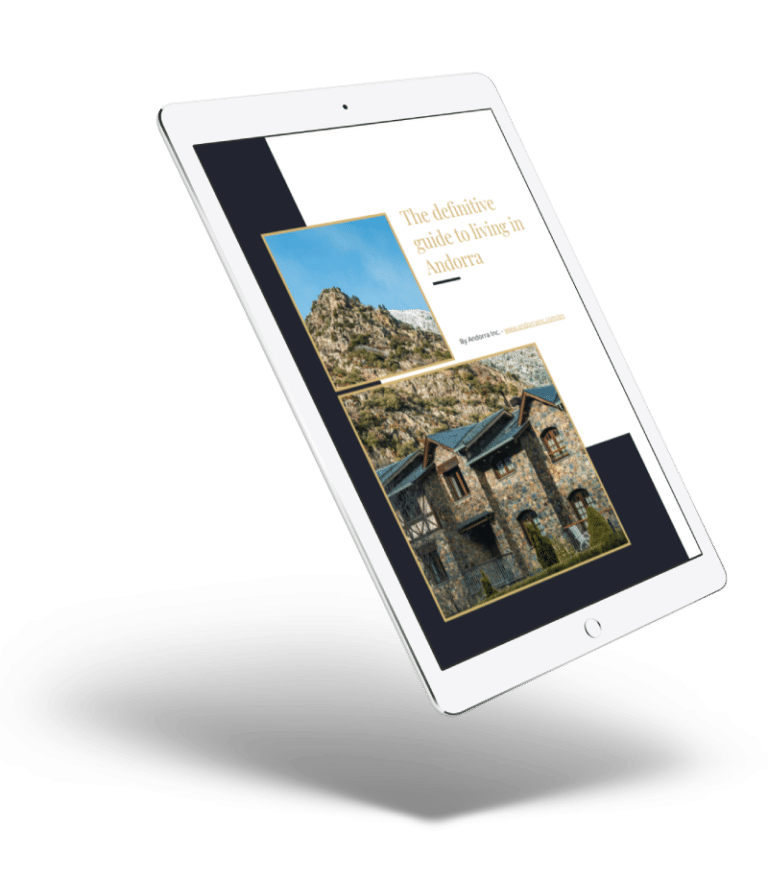
If you are considering a move to Andorra for its favorable capital gains rules, we recommend reading the report “The definitive guide to living in Andorra”, where you will find the most comprehensive information on taxes, residence permits, and daily life in the Principality.
For any other questions or specialized advice, feel free to get in touch with us. With Andorra’s growing appeal among entrepreneurs, retirees, and digital nomads, we are here to ensure you receive the best guidance tailored to your unique situation.
Sources
- Llei 5/2014, del 24 d’abril, de l’impost sobre la renda de les persones físiques (IRPF) – Portal Jurídic d’Andorra
- Llei 5/2023, del 19 de gener, de mesures per a la reforma de la imposició directa – LesLleis.com
- Convenis per evitar la doble imposició – Govern d’Andorra
- Llei 3/2024 de l’impost sobre la inversió estrangera immobiliària – BOPA
- Autoritat Financera Andorrana (AFA)
 All communications are encrypted and will be treated with absolute confidentiality. Your data will never be shared with third parties.