There are many reasons why someone might consider living in Andorra: this small principality in the Pyrenees offers excellent quality of life, high levels of security, and a tax system that is among the most advantageous in Europe. As a result, more and more people are considering moving to the country.
In this article, we will talk about the different ways to obtain a residence permit in Andorra, focusing on the self-employed active residence and passive residence, as these are the most common and relevant options for our clients.
Ways to get the residency
Andorra offers several pathways to obtain a legal residence permit:
- Active residence:
- Residence for employees: for those who have a work contract with an Andorran employer.
- Residence for self-employed (“residència per compte propi”): for those who wish to create a company or practice a liberal profession in the country.
- Passive residence: intended mainly for individuals who can demonstrate sufficient economic means or wish to invest in Andorra.
- Digital nomad visa: for remote workers who provide services to entities outside Andorra.
- Family reunification: for spouses, children, and in some cases other relatives of someone who already has a permit.
- Residence for health reasons: when there is a need for specialized medical care or care in a geriatric center.
While several routes exist, in this guide we will focus on two key options: active residence (self-employed) and passive residence. These two modalities are particularly popular among entrepreneurs, business owners, and retirees or annuitants who wish to settle in the principality.
Self-employed active residence
Known in Catalan as “residència per compte propi“, this is the permit that allows an individual to come to Andorra to work under their own structure. In other words, you will create (or be part of) an Andorran company and generate income within the country.
The process begins by creating a local company, typically a Societat Limitada (SL). Once that company is properly registered and you are appointed as its administrator, you can apply for the self-employed residence permit. The two key conditions are that you must hold more than 34% of the company’s shares and occupy a role in its administrative body.
This type of residence is particularly appealing for entrepreneurs, freelancers, and digital professionals who want to take advantage of Andorra’s tax benefits while actively engaging in local economic activity. Additionally, holders of this permit must reside at least 183 days per year within the principality, which makes sense for those who truly wish to relocate their center of activity to Andorra.
Requirements
To successfully obtain this permit, you will need to fulfill the following requirements:
- Form a company in Andorra: typically, the path starts with establishing an Andorran SL and holding more than 34% of its shares, as well as occupying a position in the company’s administrative body.
- Payment to the Andorran Financial Authority (AFA): a non-refundable payment of €50,000 to the AFA is required (a fons perdut). This amount is not returned when the residency ends, it is only reimbursed if the initial immigration authorization is denied. Certain regulated professions (“professió titulada”) such as lawyers, doctors, architects, or engineers may be exempt from this payment, provided they become officially registered in that profession in Andorra.
- Secure lodging: either own property in Andorra or have a valid long-term rental contract.
- Good conduct and health checks: a criminal record certificate (showing no major offenses), as well as a medical certificate from Andorra.
- Engage in an active business: the company must be registered as an active business within three months of the immigration application. The authorities may request evidence that your company is truly operating, generating income, or at least has the potential to do so.
- Live in the country 183 days: to maintain your administrative residence, you must effectively reside in Andorra for at least 183 days each year.
Steps
The steps usually follow this sequence:
- Establish your company and request an authorization for foreign investment (if you are not yet a resident).
- Obtain a tax registry number (NRT) for your newly formed company.
- Make the €50,000 payment to the AFA, unless you qualify for a professional exemption.
- Submit the entire dossier to Andorran immigration, including police clearance certificates, a medical examination in Andorra, and proof of accommodation.
Once all these requirements are met, you will be issued your residence card as a self-employed active resident. It is valid for an initial period of one year, then renewed three times for periods of two years each. After seven years of residency, subsequent renewals are granted for periods of ten years. You must continue to meet the criteria for each renewal.
Passive residence
The “residència passiva” is quite different. This residence permit is designed primarily for people with sufficient economic means to live in Andorra without the need to work locally. It is often known as the Andorran residence by investment because one of the most common ways to obtain it is by investing a certain amount of money in Andorran real estate, financial products, or a local company.
Under passive residence, you only need to spend a minimum of 90 days in Andorra per year, which is a significant difference from the 183-day requirement of the active permit. This option is especially appealing to retirees, investors, or individuals who can demonstrate that their income comes from outside of Andorra.
Requirements
Compared to the self-employed route, the entrance barrier is higher in terms of capital, but there is no need to set up a company locally if you do not wish to work in Andorra. Key requirements include:
- A minimum investment of €1,000,000: since January 2026 (Llei de continuïtat i consolidació de les mesures per al creixement sostenible), passive residents must invest at least €1,000,000 in Andorran assets such as real estate, financial instruments issued in Andorra, shares in Andorran companies, or collective investment funds of Andorran law. If the investment is in real estate, the minimum value per property is €800,000.
- Non-refundable payment to the AFA: a payment of €50,000 to the Andorran Financial Authority is required (a fons perdut), plus €12,000 for each dependent. This amount is non-refundable and is only returned if the initial immigration authorization is denied.
- Proving sufficient income: you must show you can sustain your lifestyle without seeking employment in Andorra. The requirement is at least 300% of the Andorran minimum wage per year (approximately €54,912 in 2026, based on the minimum wage of €1,525.33/month), plus an additional 100% for each dependent (approximately €18,304).
- Criminal record clearance and medical checks.
- Private health insurance coverage.
- Maintain a local address in Andorra: could be either rented or owned property.
Important: non-residents purchasing property in Andorra are also subject to the foreign investment tax (impost a la inversió estrangera immobiliària), which since 2026 is set at 6% for the first property and 10% for any subsequent property purchases. This is an additional cost to factor in when planning a passive residence through real estate investment.
How it is achieved
To apply for passive residence, you typically begin by making the investment in one of the approved categories, then you make the required payment to the AFA. After gathering proof of sufficient funds, insurance, and accommodation, you submit the file to Andorran immigration. If approved, you receive a residence card that must be renewed periodically.
As a passive resident, you cannot work for an Andorran company, although you may carry out administrative roles in a local business and receive any kind of passive income.
Activa vs pasiva
The main distinctions between these two options revolve around time spent in the country and working privileges. Active residence requires you to spend the bulk of the year in Andorra (183 days) and allows you to earn income from a business located there.
In both cases, residency is renewed periodically, except in the case of flagrant non-compliance with the requirements. For active residence, renewals follow the pattern of 1 year, then three periods of 2 years, then 10-year renewals. For passive residence, the initial permit is for 2 years, then renewed for 2 years, then 3 years, and then 10-year renewals.
After 20 years in the country you could, if you wish, apply for the Andorran passport.
Administrative vs tax residence
One aspect that can cause confusion is the difference between administrative residence (the immigration permit) and tax residence (the obligation or right to pay taxes in Andorra). Having an Andorran residence card does not automatically mean you qualify as a tax resident in the eyes of other countries.
Only when you meet the conditions for tax residency (most commonly, spending at least 183 days in the country and centering your economic interests in Andorra) can you fully benefit from the country’s tax advantages.
This distinction matters if you hold a passive residence but continue to spend most of your time in another jurisdiction, or if your core economic ties remain abroad. To avoid potential conflicts with foreign tax administrations, it is often best to ensure that Andorra is clearly your main base.
Andorra tax system
For those who do qualify as tax residents in Andorra, the tax landscape is highly attractive:
- The personal income tax (IRPF) has a top rate of 10%
- Income under €24,000 is exempt from taxation
- Anything up to €40,000 is taxed at 5%
- Capital gains, interest, and dividends from local sources may enjoy exemptions or be taxed at just 10%, depending on the specific circumstances
- In addition, there is no wealth tax or inheritance tax, and the general VAT (IGI) stands at only 4.5%
This makes Andorra a compelling choice for business owners, investors, and high-net-worth individuals seeking to optimize their fiscal obligations in a legitimate and transparent manner.
Interested in getting the Andorra residence?
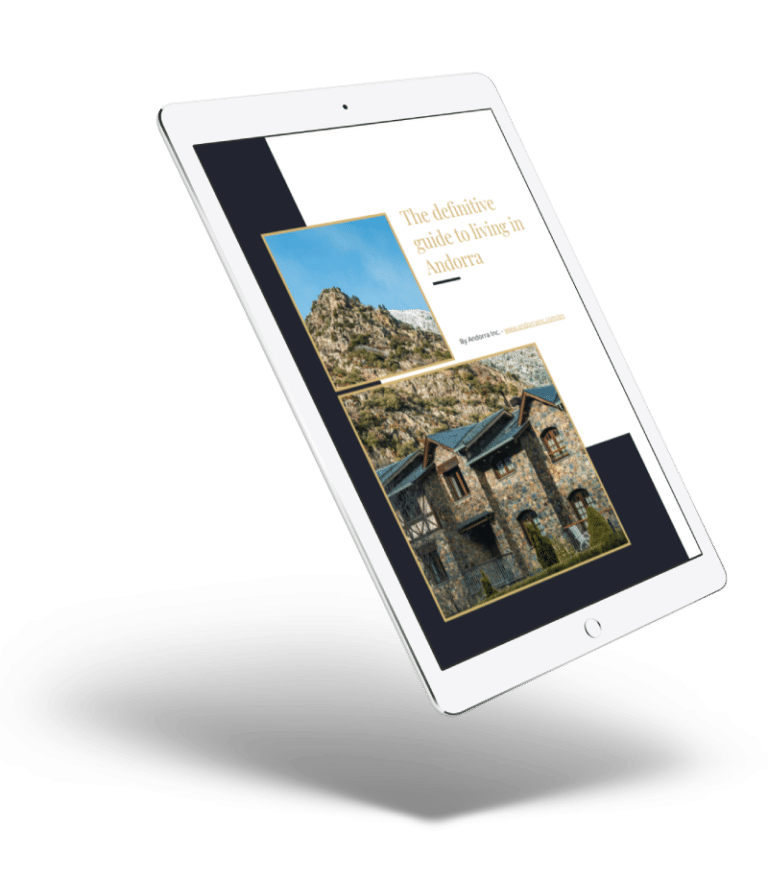
If you would like to explore obtaining a residency permit in Andorra, either through the self-employed active route or through passive residence, we invite you to get in touch with us or download our comprehensive guide “The definitive guide to living in Andorra”.
Our experts will be happy to assess your situation, recommend the most suitable route, and guide you step by step in your move to the principality.
Sources
- Govern d’Andorra, Residència i treball per compte propi: autorització inicial
- Govern d’Andorra, Residència sense treball: autorització inicial
- Consell General, Projecte de llei de continuïtat i consolidació de les mesures per al creixement sostenible (approved January 22, 2026)
- Llei 5/2025, del 6 de març, per al creixement sostenible i el dret a l’habitatge (BOPA)
- Autoritat Financera Andorrana (AFA)
- Govern d’Andorra, Salaris i festius (salari mínim 2026)
 All communications are encrypted and will be treated with absolute confidentiality. Your data will never be shared with third parties.