Andorra, the small principality nestled in the Pyrenees between Spain and France, has become increasingly attractive to those seeking a high quality of life combined with lower taxation. Over the past few years, more and more people have been relocating to Andorra, lured by its political stability, security, and advantageous tax system.
However, one aspect that can cause confusion among newcomers is the difference between administrative and tax residence.
These two concepts often overlap but do not necessarily coincide, so in this article, we will clarify the main differences between administrative residence (the permit to legally reside in the country) and tax residence (the right and obligation to pay taxes in Andorra).
Administrative vs tax residence
The first step to understanding how Andorra’s immigration and tax systems work is to differentiate between these two concepts:
- Administrative residence: This is the legal permission granted by the Andorran government allowing you to reside within the country’s borders. It takes the form of a residence card or “green card,” which indicates you are an authorized resident. Administrative residency can be “active” (linked to employment or self-employment) or “passive” (linked to investment or sufficient means).
- Tax residence: This defines where you are deemed to reside for tax purposes. In other words, it is about which country has the right to tax your global income. Tax residency usually depends on the number of days you spend in a country, as well as where your economic, family, and social ties are primarily located.
Crucially, holding an administrative residence permit in Andorra does not automatically mean you are a tax resident there.
You may qualify for a passive residence permit that only requires you to stay in Andorra 90 days a year, but if you end up spending the rest of the year in another country where you have substantial ties, you could be considered a tax resident of that other country.
Andorra administrative residence
Andorra offers multiple pathways to obtain a valid residence permit. Each one is tailored to a specific profile, but they can be summarized in three main categories:
- Active residence: this can be obtained by individuals who work in Andorra under an employment contract or by those who create and manage an Andorran company, typically known as the “residence for self-employed.” Holders of an active residence must usually spend at least 183 days per year in Andorra. Self-employed applicants must make a non-refundable payment of €50,000 to the Andorran Financial Authority (AFA) and hold a minimum 34% stake in an Andorran company in which they exercise effective management.
- Passive residence: also referred to as “residence without a lucrative activity,” this is for those who can demonstrate sufficient economic means or wish to invest in Andorra. Following the approval of the Llei de continuïtat i consolidació de les mesures per al creixement sostenible (the so-called “Omnibus 2” law) by the Consell General in January 2026, the minimum requirements have been significantly tightened. Applicants must now invest at least €1,000,000 in Andorran assets (if investing in real estate, each property must be worth a minimum of €800,000). In addition, a non-refundable payment of €50,000 must be made to the Andorran Financial Authority (AFA), plus €12,000 per dependent. This payment is definitive and will not be returned, even if the applicant later decides to leave the country. Passive residents only need to spend 90 days per year in Andorra to maintain their permit.
- Digital nomad or entrepreneur visa: a newer category designed for individuals who primarily work online for clients or companies based outside Andorra. The professional must be based in Andorra and at least 85% of the services they provide must be used outside the principality. They may employ a maximum of one person. Like all other types of administrative residence, it grants you the right to stay in the country but does not automatically qualify you for tax residency if you do not meet certain criteria (such as spending sufficient days in the country).
There are also other routes, such as family reunification or residence for health reasons, but the bulk of new residents typically fall under the “active” or “passive” categories.
No matter which permit you obtain, remember that fulfilling the administrative requirement does not in itself make you a tax resident. It is crucial to evaluate your personal situation carefully, especially if you are seeking to minimize your tax exposure in a legitimate manner.
It is also worth noting that Andorra has recently strengthened its immigration controls. The simulation of residence, the falsification of requirements to obtain a permit, and marriages or partnerships of convenience entered into solely to obtain residency are now classified as very serious infractions that can result in the cancellation of the permit and significant fines.
Securing the tax residence
To be considered a tax resident in Andorra, the Andorran Personal Income Tax Law (Llei 5/2014) states that you must meet at least one of these criteria:
- Spend more than 183 days during a calendar year in Andorra. Temporary absences, such as vacations or short business trips, are often still counted as days spent in Andorra if you can prove your center of life is here.
- Have the center of your activities or economic interests in Andorra. This generally means that the majority of your income or assets is generated or located in the principality. In practice, this is assessed by looking at where your company operates from, where your main bank accounts are held, where your clients or revenue sources are based, and where you carry out the day-to-day management of your business or professional activity.
Additionally, there is a presumption of Andorran tax residence if your spouse or dependent children reside in Andorra. This is an important point that many overlook: even if you personally spend fewer than 183 days in the country, having your family established here can lead to the Andorran tax authorities (and foreign ones) presuming that your true center of life is in Andorra.
The critical takeaway is that tax residency is determined by the actual facts of your daily life, where you spend most of your time, where your family and business interests are, and how you connect to the territory. Merely holding a “green card” (administrative residence permit) does not give you a free pass to be taxed under Andorran rules.
To enjoy Andorra’s low taxes, you must meet the substantial presence requirements and ensure that your primary ties are within the country.
The 90 days myth
A common misconception, sometimes perpetuated by uninformed advisors, is that if you hold a passive residence permit (requiring only a 90-day stay) you can magically become a tax resident of Andorra. This is not correct.
If you spend just 90 days in Andorra and the other 275 days in another country, tax authorities in that other country will likely consider you a tax resident there. For example, spending the remainder of the year in Spain, France, or your home country would almost certainly trigger tax residency obligations there, not in Andorra.
While it is true that administrative passive residence demands only 90 days per year in the principality, this does not align with the 183-day threshold commonly used to establish tax residency. If your goal is to legitimately pay taxes in Andorra, the safest approach is to ensure you do not exceed 183 days outside the country and that your primary economic and family interests are here. Otherwise, the “90 days rule” can expose you to scrutiny and conflict with foreign tax authorities.
This is especially relevant for individuals coming from countries like Spain or France, where tax authorities have dedicated units to monitor residents who claim to have relocated abroad. Having a genuine life in Andorra (your home, your daily routines, your social connections, your banking, your healthcare) is what ultimately matters.
The tax residency certificate
Once you meet the conditions to be considered a tax resident in Andorra, the next practical step is to obtain the official tax residency certificate (certificat de residència fiscal) issued by the Departament de Tributs i de Fronteres (DTF), the Andorran tax authority.
This document is essential in practice. It serves to prove your Andorran tax residency to foreign administrations, banks, and any entity that needs to verify where you pay taxes. It is also the document required to correctly apply double taxation treaties (CDIs) and to avoid withholdings on income received from abroad, such as dividends, interest, or pensions.
The DTF issues two versions of the certificate: a standard certificate, used to accredit tax residency before entities in countries with which Andorra does not have a CDI in force, and a CDI-specific certificate, used exclusively before entities in countries where a double taxation treaty applies. For certain countries like France and Spain, there are also specific forms (such as the FR-5.000 for French-source capital income or the 030-ES for Spanish-source income) that must be completed by the taxpayer, certified by the DTF, and then submitted to the paying entity abroad.
In the application form itself, the taxpayer must declare the legal basis for their tax residency: either that they reside more than 183 days per year in Andorra, or that the center of their economic interests is located in the principality.
An important development since 2025 is that the DTF has significantly tightened its verification process when issuing these certificates, particularly during the applicant’s first year as a resident. It is no longer enough to simply hold a valid residence permit and submit the form. The authorities now routinely request concrete evidence of effective, day-to-day life in Andorra before approving the certificate. This may include bank statements showing regular transactions in the country, receipts for everyday expenses (supermarkets, pharmacies, restaurants), lease agreements and proof of rent payments, telecommunications records, and even documentation from local services such as gym memberships or medical visits. The banking trail, in particular, has become one of the most closely reviewed elements.
This stricter approach reflects the broader trend, both in Andorra and in surrounding countries, toward ensuring that tax residency changes are genuine and not merely formal. For anyone planning to relocate to Andorra, the practical advice is clear: start documenting your presence and daily life in the country from day one. Without sufficient evidence, obtaining the certificate can be delayed or denied, which in turn can create problems with the tax administration of your country of origin.
Thinking of moving?
If you are considering relocating to Andorra, the first step is to consult with tax experts in your country of origin and in Andorra. Each case is unique, and a personalized analysis can help you avoid costly mistakes. Whether you choose active residence, passive residence, or a digital nomad visa, meticulous planning will safeguard your financial interests.
Keep in mind that Andorra’s immigration and tax landscape has evolved rapidly in recent years. The Llei 5/2025 (the first “Omnibus” law) and the subsequent Llei de continuïtat i consolidació de les mesures per al creixement sostenible (the “Omnibus 2” law, approved in January 2026) have introduced substantial changes to investment thresholds, deposit requirements, and immigration controls. Working with professionals who are up to date on the latest regulations is essential.
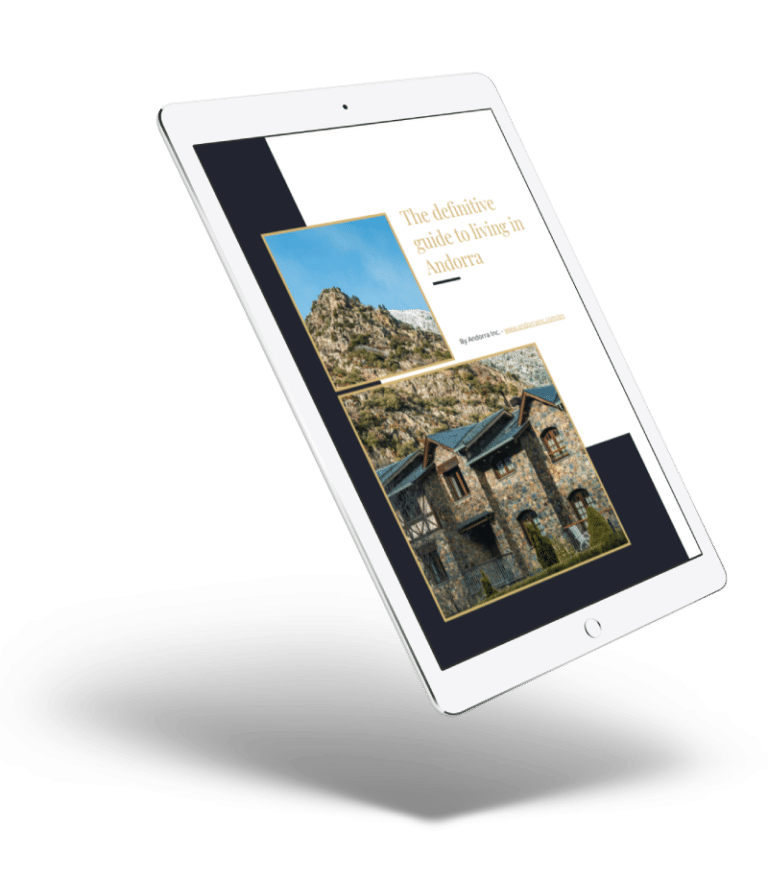
We invite you to read the report “The definitive guide to living in Andorra” for in-depth insights on the country’s residency options, tax system, and lifestyle. For any questions or clarifications about your specific situation, feel free to reach out.
Last updated: February 2026
Sources
- Llei 5/2014, de l’impost sobre la renda de les persones físiques (Portal Jurídic d’Andorra)
- Llei 5/2025, per al creixement sostenible i el dret a l’habitatge (Portal Jurídic d’Andorra)
- Llei de continuïtat i consolidació de les mesures per al creixement sostenible, approved January 22, 2026 (Consell General)
- Reglament de les autoritzacions d’immigració de residència sense treball (Portal Jurídic d’Andorra)
- Normativa i legislació d’immigració (Govern d’Andorra)
- Certificat de residència fiscal a Andorra (Seu Electrònica, Govern d’Andorra)
- Formularis de certificació de residència fiscal (Departament de Tributs i de Fronteres)
- IRPF Information (Govern d’Andorra, Seu Electrònica)
- Autoritat Financera Andorrana (AFA)
 All communications are encrypted and will be treated with absolute confidentiality. Your data will never be shared with third parties.