
Nestled in the heart of the Pyrenees between Spain and France, Andorra has long been celebrated for its remarkable natural beauty, high quality of life, and security.
However, one of the most compelling reasons individuals and businesses alike consider moving to Andorra is its highly attractive tax regime. With low personal and corporate tax rates, no wealth or inheritance taxes, and a modest value-added tax (called IGI), the Principality is an appealing destination for entrepreneurs, high-net-worth individuals and retirees.
In today’s article we explore the main taxes that exist in the Principality.
1. Personal income tax (IRPF)
Andorra’s personal income tax, known locally as IRPF (“Impost sobre la Renda de les Persones Físiques”), is known for its simplicity and low rates compared to most European countries.
The IRPF is structured around two separate tax bases:
General base (employment income, business income, rental income): the tax rate is a flat 10%, but with two important reliefs:
- The first €24,000 of income is completely exempt.
- A bonification of up to €800 is applied to the tax liability for income between €24,000 and €40,000, which effectively reduces the burden on that bracket to roughly 5%.
Above €40,000, the full 10% applies with no further reductions. For instance, someone earning €70,000 per year would pay approximately €3,800 in total income tax, a significantly lower burden than in Andorra’s neighboring countries.
Savings base (interest, foreign dividends, and financial capital gains): the rate is also 10%, but the first €3,000 of savings income per year is exempt. Dividends received from Andorran companies that have already paid the 10% corporate tax are fully exempt from the savings base.
This dual structure is important to understand: while the general base applies to your salary and business income, the savings base governs your investment income and has its own separate exemption.
2. Corporate tax
For businesses, Andorra’s corporate tax is a major draw. The headline corporate tax rate in the Principality is 10%, levied on company profits (income minus expenses). This rate is among the lowest in Europe. By comparison, Spain imposes a standard 25% on corporate profits, while France’s rate has historically hovered around 30% or more.
Additionally, Andorra allows negative tax bases to be carried forward and applied against future profits for up to 10 years, reducing future corporate tax bills when a company experiences losses.
If you also serve as a shareholder and reside in Andorra, you may find further advantages when it comes to how dividends are taxed, an aspect we delve into later in this guide.
3. Capital gains from the sale of shares
Capital gains on company shares in Andorra depend on both the percentage of ownership and the holding period. The general rule is:
- If you own 25% or less of a company: the gains from selling those shares are completely exempt from tax. This exemption can be appealing to small-scale investors, minority shareholders, or those actively diversifying their portfolios.
- If you own more than 25% of the company: any gain realized upon the sale is subject to a 10% tax rate.
- Exemption after 10 years: if you have held those shares for at least 10 years, the capital gain becomes tax-free, regardless of your ownership percentage.
Important exception: since the entry into force of Llei 5/2023 on 1 January 2024, shares in companies whose assets are 50% or more composed of Andorran real estate do not benefit from the ≤25% exemption. Instead, they are taxed under the real estate capital gains rules described below. This is particularly relevant if you hold property through an Andorran company structure.
This tiered system rewards long-term shareholding and encourages stable investment. For example, a business founder who has held more than 25% of a company’s equity for over a decade can sell all or part of that position completely tax-free. Meanwhile, an investor who invests in minority stakes (≤25%) in non-real-estate companies can generally sell at any time without incurring capital gains tax.
4. Capital gains from the sale of real estate
The taxation of real estate capital gains was significantly reformed by Llei 5/2023, which came into force on 1 January 2024. The old standalone capital gains tax (Llei 21/2006) was derogated and real estate gains are now integrated into the IRPF, the corporate tax (IS), and the non-resident income tax (IRNR).
The current regime depends on who is selling:
Resident individuals (IRPF):
- Sales within 2 years of purchase: 10% tax plus a 5% speculative surcharge, for a total of 15%.
- Sales after 2 years: 10%.
- From 5 years onwards: reduction coefficients progressively reduce the taxable gain.
- After 10 years: full exemption (0%).
Companies (IS):
- Sales within 2 years: 10% plus the 5% speculative surcharge = 15%.
- Sales after 2 years: flat 10%, with no reduction coefficients and no exemption after 10 years.
Non-residents (IRNR):
- Sales within 2 years: 15%.
- Sales after 2 years: 10%, with no reduction coefficients.
The distinction between these three categories is crucial for tax planning. The 10-year exemption that makes Andorra so attractive for long-term property investors applies only to resident individuals, not to companies or non-residents. For more details, read our guide on capital gains in Andorra.
5. Dividend taxes
For individuals who are tax residents in Andorra, the taxation of dividends follows a clear distinction between local and foreign-sourced dividends:
- Dividends from an Andorran company paid to an Andorran tax resident: taxed at 0%. This effectively eliminates the double taxation of profits often seen in other countries. If you run your own Andorran company and pay yourself dividends, you do not incur additional tax on top of the 10% corporate rate.
- Dividends from non-Andorran companies: these are taxed at 10% as savings income under the IRPF, although the first €3,000 of total savings income per year is exempt. Double taxation treaties or foreign withholding taxes may also reduce the net amount you pay through deductions for taxes already paid abroad.
For many entrepreneurs, digital nomads, or international investors who choose to relocate to Andorra, the 0% rate on local dividends is particularly powerful. Not only can you limit your business’s corporate tax to 10%, but also you can extract post-tax profits without further local taxes.
However, the absence of double taxation treaties with some countries could increase this tax bill. For more information, we recommend reading our guide on dividend taxes in Andorra.
6. IGI (Andorran VAT)
The Principality’s indirect tax on goods and services is called IGI (short for “Impost General Indirect”). It is essentially a Value-Added Tax but is lower than in most EU countries. The general IGI rate is 4.5%, which is markedly less than the 21% in Spain or 20% in France.
The full rate structure is:
- 0% (exempt): medical, educational, social, financial, and postal services.
- 1% (superreduced): food, books, water, newspapers, and certain cultural activities.
- 2.5% (reduced): passenger transport, certain cultural and sports events, and some tourism services.
- 4.5% (general): the standard rate for most goods and services.
- 9.5% (special): banking and financial services.
For businesses with cross-border operations, the relatively low IGI can be an advantage when selling to consumers within Andorra. However, it is important to remember that, because Andorra is outside the EU, separate rules and treaties may govern the import and export of goods into or out of the EU single market.
7. Inheritance, gifts, and wealth
Perhaps one of the most distinctive features of Andorra’s tax regime is the absence of wealth, inheritance, or gift taxes. Unlike many European jurisdictions that impose significant levies on large estates, net worth, or intergenerational transfers, Andorra does not burden taxpayers in these areas.
- No inheritance tax: heirs in Andorra receive assets, real estate, or financial instruments without paying additional taxes. This is a major advantage for those planning their estates or looking to create multigenerational wealth.
- No gift tax: gifts made to children, spouses, or other parties are not subject to any local gift tax. This policy again makes Andorra an appealing domicile for high-net-worth families seeking simpler ways to transfer assets.
- No wealth tax: residents do not pay annual taxes on the total value of their assets, whether in Andorra or abroad. Countries like Spain and France, by contrast, apply wealth taxes above certain thresholds.
This trio of “no inheritance, no gift, no wealth tax” sets Andorra apart as one of the most favorable environments in Europe for preserving and passing on wealth.
8. Foreign investment tax on real estate
A specific tax on foreign investment in real estate was introduced to help moderate rising housing prices and ease local affordability issues. The law applies to individuals or entities that have not been residents of Andorra for at least three years, as well as foreign legal entities or Andorran companies with 50% or more foreign ownership.
Following the approval of the Llei de continuïtat i consolidació (Omnibus 2, January 2026), the rates were significantly increased and simplified:
- 6% on the purchase of the first property.
- 10% on any subsequent properties.
This tax is not an annual levy but rather a one-time charge applied at the moment of purchase. It effectively adds a significant extra cost for foreign investors and larger real estate players, encouraging them to become longer-term residents if they plan to acquire property in the Principality.
9. Non-resident income tax (IRNR)
The IRNR (Impost sobre la Renda dels No-Residents Fiscals) applies to individuals and entities that earn income from Andorran sources without being tax residents. The standard rate is a flat 10% on most income types, including salaries for work performed in Andorra, business income from an Andorran establishment, and rental income from Andorran properties (with a 20% automatic reduction on gross rental income, resulting in an effective rate of 8%).
Notably, dividends and interest paid from Andorran sources to non-residents are not taxed under the IRNR, making the Principality especially attractive for foreign investors holding stakes in Andorran companies.
For property sales by non-residents, the capital gains rules described in section 4 above apply (15% within 2 years, 10% thereafter, with no reduction coefficients).
Difference between administrative and tax residence
Once the country’s main taxes have been discussed, it is relevant to clarify the difference between simply holding an Andorran residence permit (administrative residence) and being recognized as a tax resident in the country.
While obtaining a residence card is indeed the first step, true tax residence in Andorra typically hinges on several key factors:
- Physical presence: spending at least 183 days per year in the Principality is the standard benchmark (although less may be accepted in some specific cases).
- Center of vital interests: often, your primary economic interests, family, or personal ties must also be located in Andorra. If your main family home, bank accounts, and most valuable assets remain elsewhere, or if you spend more days in another jurisdiction, you may struggle to claim Andorran tax residence if challenged by a foreign tax authority.
- Consistent documentation: being able to show flight records, local utility bills, and financial statements that corroborate your actual presence in Andorra is often critical in any dispute regarding tax status.
Holding the administrative residence card alone does not guarantee that another country cannot assert taxation rights over you. Therefore, for individuals truly seeking Andorra’s lower taxes, the best practice is to both acquire the residence permit and meet the traditional 183-days-per-year threshold.
This dual approach leaves little ambiguity, both with local authorities and in the eyes of foreign tax administrations.
Getting the residence permit
While Andorra is not a member of the European Union, it offers several pathways to legal residence. Broadly speaking, these include:
- Active residence
- Passive residence
- Digital nomad visa
- Family reunification permits
- Residency for health reasons
However, the two most sought-after options are active and passive residence.
Active residence (self-employed or employed) allows you to work in Andorra, whether under contract or through your own company. For example, if you choose the self-employed route, you will typically create an Andorran limited liability company, own more than 34% of it (raised from 20% by Llei 5/2025), and act as the administrator. The company must be registered within three months of obtaining the permit.
This status requires a €50,000 payment to the Andorran Financial Authority (AFA), which following the Llei de continuïtat i consolidació (January 2026) is now non-refundable (a fons perdut). It is only returned if the initial authorization is denied. Regulated professionals (like doctors and engineers) may be exempt from this payment. You also need to spend 183 days a year in the country.
Passive residence, meanwhile, is designed for retirees, investors, or anyone who can demonstrate sufficient income from outside Andorra. This option only requires you to spend 90 days a year in the Principality, but following the January 2026 reform, you must invest a minimum of €1,000,000 in approved Andorran assets (previously €600,000). If the investment includes real estate, the minimum property value is €800,000 and it must be used as a primary residence. Additionally, you must pay €50,000 to the AFA (non-refundable), plus €12,000 per dependent, also non-refundable.
Both permit types involve a criminal-record check, medical certificate, and proof of suitable accommodation. After approval, you will receive an Andorran residence card, renewable periodically, that grants multiple advantages, including the possibility of achieving full tax residence if you meet the 183-day rule.
For a full breakdown of all residency requirements, see our dedicated guide. Andorran citizenship (the nationality), on the other hand, is very difficult to obtain, since, except for family ties, it requires having resided in the country for at least 20 years.
Thinking of moving to Andorra?
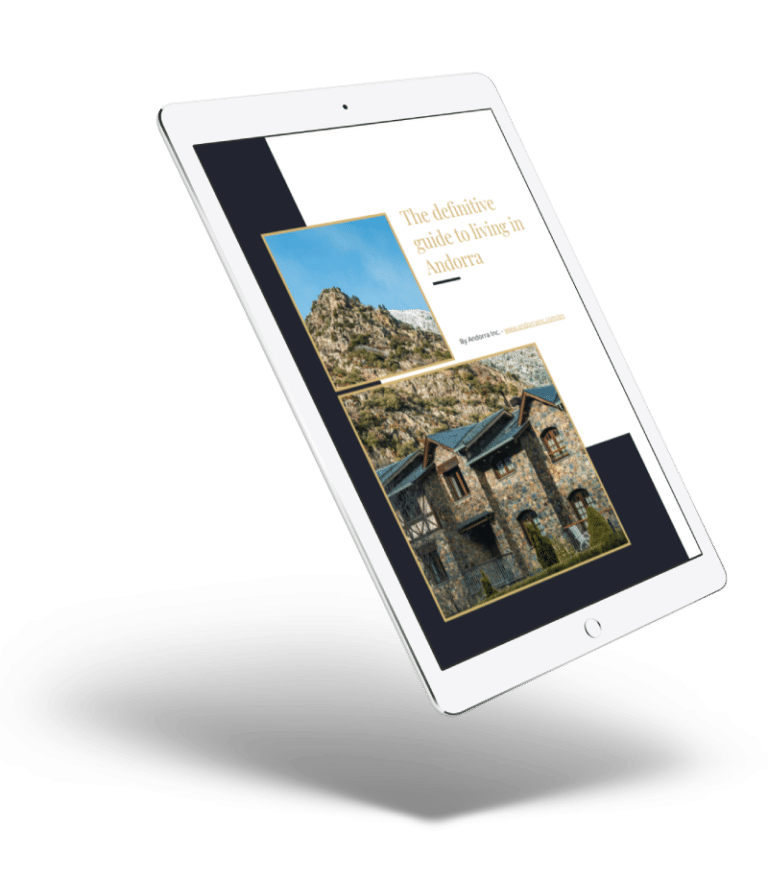
If you are considering a move to Andorra for its favorable tax system, we recommend reading the free report “The definitive guide to living in Andorra”, where you will find the most comprehensive information on taxes, residence permits, and daily life in the Principality.
For any other questions or specialized advice, don’t hesitate to get in touch with us.
Sources
- Llei 5/2014 – Personal Income Tax Law (Consell General)
- Llei 5/2023 – Direct Tax Reform (Consell General)
- Llei de continuïtat i consolidació – Omnibus 2 (Consell General, January 2026)
- Llei 5/2025 – Immigration Reform (BOPA)
- IRPF Overview (Govern d’Andorra, e-tramits)
- Corporate Tax Overview (Govern d’Andorra, e-tramits)
- Active Residence Requirements (Govern d’Andorra)
- Passive Residence Requirements (Govern d’Andorra)
- IRS – Withholding on Specific Income
 All communications are encrypted and will be treated with absolute confidentiality. Your data will never be shared with third parties.